Potluck party with dear friends and colleagues

After quitting my first job in Chiba, I returned to Hiroshima and went on my next journey as an interpreter for factory training assigned to Indian technicians. I joined a group of over 10 interpreters, assisting the technicians with their health checkups, safety training, hands-on training of aircraft parts assembly ✈️ and more. But as the work environment changes, so do the terms used, and there were many things I was encountering for the first time, so I learned a ton together with them.

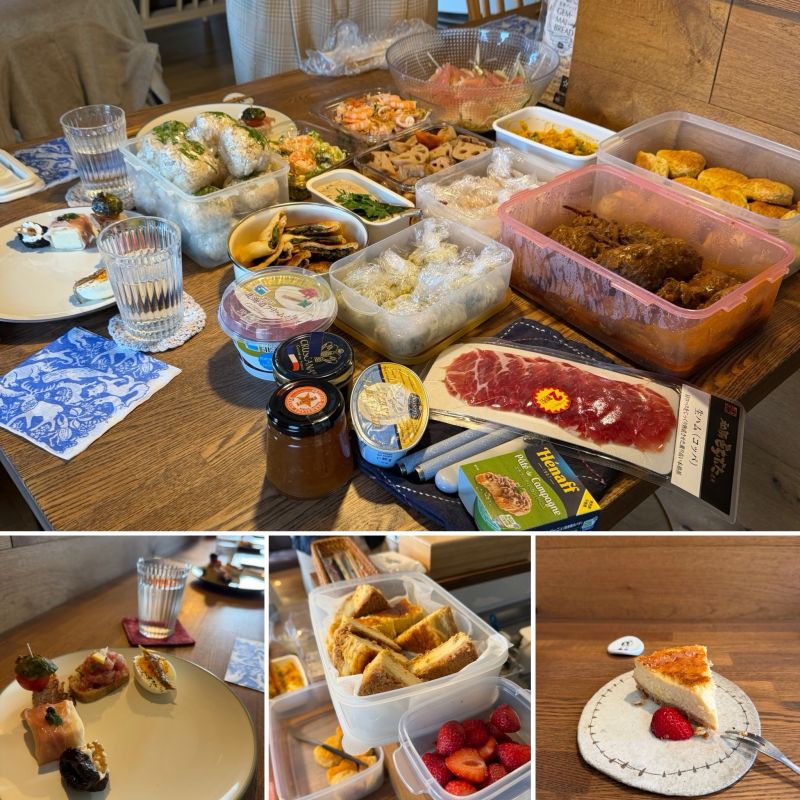
My fellow interpreters from back then—we still keep up our friendships, getting together for meals a few times a year and such. The interpreting project was in 2010, so it’s been 16 years since then. Last Saturday, we had our annual New Year’s potluck party. It’s the style where everyone brings one or two dishes. This time, I made stewed hamburg steaks which I learned from my mother, and scones using an authentic British recipe. The menus we bring are different every time, so it’s always something to look forward to.

Once we’d eaten our fill, we connected a remote call with the friends who live far away and can’t meet in person, and it was time for the “This Year’s One-Character Resolution” session 💻 We reflected on last year’s character and shared our picks for this year. Mine is “読” (read), which I posted about on LinkedIn the other day. My goal this year is to tackle my pile of unread books… 📚

After wrapping up the call, we continued enjoying the food while chatting about work and personal updates, including some pretty private and deep topics like retirement savings plans 💡 It was a really fulfilling time. Connections formed outside of schools, and being able to maintain such deep friendships—it’s truly a precious bond, I think.

Up to now, I’ve met all sorts of people in both my professional and personal life. Clients I’ve gotten to know through interpreting and translation work, international students I met at my previous university job, fellow professionals connected via industry groups like DVÜD e.V. or JAT, and through LinkedIn or X—I want to cherish all these ties. And I hope to meet them finally in-person or see them again 🙂

Started the teeth alignment (orthodontic treatment)

I’ve always wanted to show a smile with confidence. When I studied abroad in Germany back in my early 20s, every person I met had a bright smile and well-aligned teeth with confidence, and I remember that wish becoming stronger and stronger. It is said that Japan has a lower rate of orthodontic treatment compared to Germany or America: while it’s 50-60% of the population in Germany and America, in Japan it’s estimated to be only 10-20% 🦷

The orthodontic treatment is however expensive in Japan; far more than that of Germany. It was tough to get everything ready, so I’ve been putting it off for long 😅, with the feeling smoldering that I want to do it someday. But… finally, I started mouthpiece orthodontics last week 💸(←)

At home, my mom loves cooking, and she often asks me to try how it tastes, when she makes new dishes or food to give to others. This morning she asked again, but I realized that taking off and putting on the orthodontic appliance is a hassle, so I can’t do it casually for the time being, and I felt a bit sad. But, being motivated by the hope that my future will have more smiles, I’ll do my best to accomplish the orthodontic treatment. The simulation results show that by the end of the year, my front teeth will be reasonably well-aligned, if things go smoothly. That really motivated me a lot. I hope, next year, I can have a profile picture with a big, beaming smile that also reflects and conveys my sincerity in my work 😊

The advancement of AI and the future of Japanese language

With the development of remote technology during the pandemic, global connections have rapidly increased, and along with that, opportunities for international communication and the demand for translation/interpreting from such opportunities have grown. In recent years, I’ve seen more job posts for in-house translators. On the other hand, the same job postings keep appearing. It could indicate that either they can’t reach the required number of people, or it’s hard to find candidates who meet the requirements. In Japan, while there are more young people who are more open to languages or skilled in communicating in foreign languages compared to the past, there are various factors that prevent allocating personnel specifically to language-related tasks. Labor shortages are one of them.

Labor shortages are common in every industry, and there are tasks that are more prioritized. That’s why some people handle translation as an ancillary duty alongside their main responsibilities. This means that there will be times when they can’t always handle all translation tasks, so the business of outsourcing translation remains in demand (I’m grateful for that as a freelancer). Indeed, outsourcing for translations where just grasping the gist is sufficient has decreased significantly, but requests from clients who want us to read between the lines and translate beyond what’s explicitly written continue to come in.

Going back to the labor shortage I mentioned earlier, I saw a statistical estimate that in 50 years, Japan’s population will be about two-thirds of what it is now. Looking just at Japan domestically, I thought that further development of AI is absolutely essential, both physically (like robots for serving, caregiving, warehouse work, etc.) and virtually like Agentic AI. That’s how we’ll compensate for the labor shortage.

With an estimated 80 million people in 50 years, if Japan—and the Japanese economy—remains a valuable entity from the world’s perspective, the market for Japanese language will somehow continue, but in 400 or 500 years? Japanese language would disappear in 900 years. It’s a far-distant future that I won’t get to see, but thinking about it feels incredibly sad.

Prayer for business prosperity

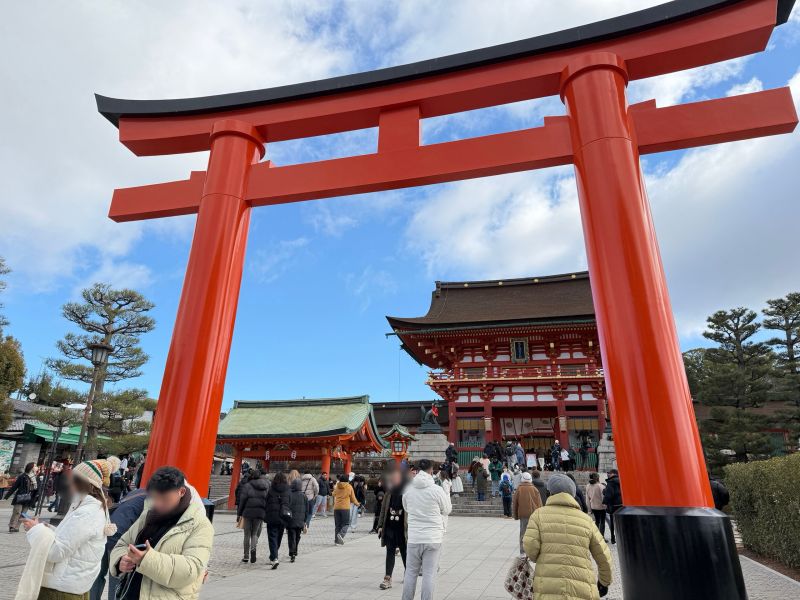
Japan is famous for its shrines and temples. One part of Japanese culture is the New Year’s visits to shrines or temples. People go on to those places of pilgrimages to pray for peace, health, and/or improved fortune for the year.

Since I started working as a freelancer, every year I visit the Fushimi Inari shrine in Kyoto (usually in January), and have a prayer performed for business prosperity in the coming year. In 2026, I visited the Fushimi Inari shrine for the prayer today, January 25 (Sunday) ✨

It generally starts with paying the offering (hatsuhoryo) at the shrine office and registering for the prayer. At the Fushimi Inari shrine, you then proceed to worship at the main hall, where a norito (Shinto prayer) is recited, incorporating your wishes, address, name, and so on. After the norito is recited, you perform the tamagushi hairei (offering of a sacred branch), receive the osagari (items like amulets or sacred sake given after the prayer), and that’s the end. Depending on the amount of the offering paid, there may also be a chance to view a kagura dance afterward.

Since it’s only once a year, I always double-check the etiquette. During the prayer, the aforementioned tamagushi hairei involves the following steps:

  1. Receive a tamagushi branch from the priest (support the root of the branch with your right hand and gently support the leafy side with your left hand).
  2. Rotate the tamagushi horizontally 90 degrees clockwise, and express gratitude and/or make a vow.
  3. Then rotate it another 180 degrees clockwise, and place it onto the stand with the branch base facing the altar.
  4. Perform two bows, two claps, and one bow.

At the main hall, dozens of groups are ushered in and worship together. During the tamagushi hairei, you perform one after another without waiting for the previous group/person to finish: one group is called, then the next, and you receive the tamagushi, place it, and so on. However, for the first group/person, it’s not done in that flow: instead, they have to do it alone; the second group and onwards must wait. This time, unexpectedly, I was the one called 🤯 I had checked the etiquette in advance, but the surprise made me nervous and flustered, and I ended up asking the priest to confirm the procedure 😂 It was a bit embarrassing. Next year, I want to pull it off smartly.

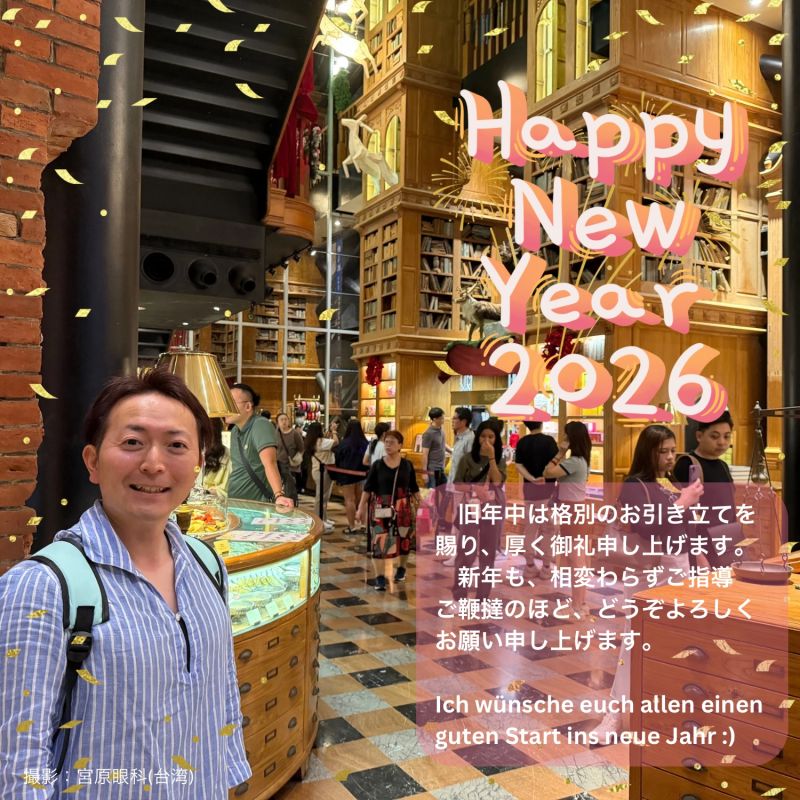
Happy New Year 2026!

My last year’s resolution in one Japanese character was 律 or discipline. Reflecting on lazy side of myself, I spent the year being strict with myself making progress toward achieving results. While being busy, I was happy that I was able to organize my surroundings and maintain good health throughout the year. Moreover, it was a year of revived motivation for learning in which I obtained a certificate of German exam that I had challenged for long. This year, I will promise “to read” a lot as my New Year’s resolution, and along with clearing my backlog of unread books 😂, I intend to diligently study toward getting a new qualification.

I wish you all a good start into the new year and a further leap forward ✨